Here you can find Solar Panels and technological accessories related to Solar Energy: Click Here If you want to learn about Solar...
Here you can find Solar Panels and technological accessories related to Solar Energy: Click Here
If you want to learn about Solar Panels, to advise you before buying or to build your own Solar Panel: Click Here
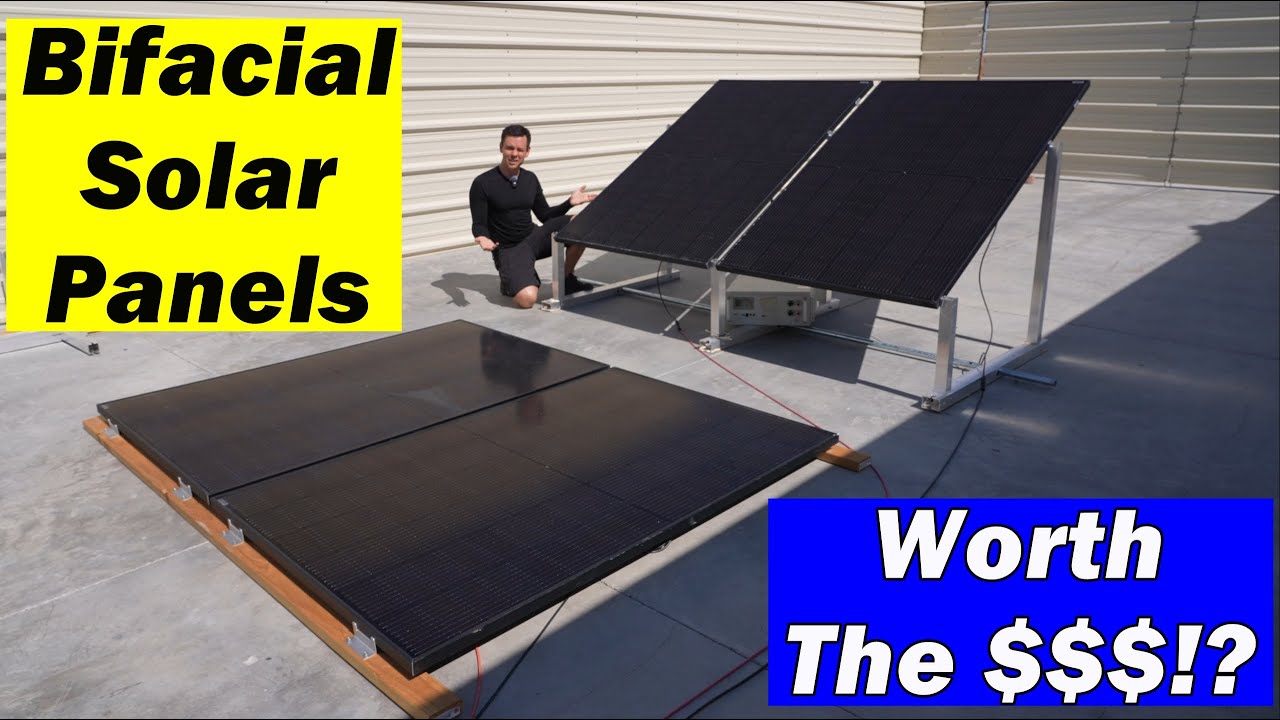
so these are bfacial solar panels they absorb sunshine from the front and the back but how much of a difference does it make so for the last 10 days I've been collecting data on how much these are producing now when it's mounted like this you should get practically no bfacial gain and it will be running at a higher temperature because there's not much convective air flow down below but when you lift them up like this you're now absorbing sunshine from the back from the reflections and with all these white walls it's a perfect spot for bfacial gain also when you lift them up it decreases the cell temperature because you have convective air flow from behind which increases the output so in theory this should output more over the course of a day but this configuration has one advantage when the sun is directly overhead when you have maximum output when most of the day generation occurs this is at a better angle but does it make that big of a difference so I collected data for the last 10 days and we had cloudy days sunny days cool days everything and this array up front generated 45.2 kilowatt hours but the one in the back did 50.7 kilowatt hours which means having it mounted like this increase the output over the course of 10 days by 12.16% but this ground mount array costs a lot more money than those pieces of wood each one of these is $100 and this solar panel is $140 so even though this has a better output over the course of multiple days you're almost always better off getting more solar panels and putting them everywhere you possibly can obviously I still recommend this more because it's super strong and it looks fantastic but the bfacial gain in this environment and in Las Vegas during the summer was only 12% now if you had snow behind these panels and it was really cold these bfacial panels will produce a lot more power but out here in the desert not so much now we're going to change this test we're going to take these solar panels off of these pieces of wood because they're raised about an inch and a half if we drop it down to the floor the temperature will rise and the output will decrease even more but by how much i have no idea when you have it lifted up just a tiny little bit it actually allows for quite a bit of cooling this mounting configuration is very similar to mounting on a roof of a house that last little bit makes actually a big difference and this is how I'm testing these solar panels so we have identical solar charge controllers connected to a battery with equal length conductors so the voltage they see is the same and these inverters discharge the battery so it's at a very low state of charge all day long and now the test is running so we'll come back in a few days 2 days later and we have some results now for the 10-day test I had two panels hooked up to one solar charge controller and two panels connected back here but for this test I only hooked up one panel the left one on the first day this one pulled 2.04 kilwatt hours and the one behind it pulled 2.31 kilowatt hours but for day two this one pulled 2.05 kwatt hours and this one pulled 2.32 so they're both within 0.01 of a kilowatt hour which is why Las Vegas is the best place to test solar panels but you'll realize that is only a 13% increase which is only a 1% difference than having it lifted up an inch so I was pretty confused i was expecting more so I looked up the data from the 10day test and I realized that on hot sunny days the difference between these arrays was only 7 to 10% but on cloudy days or cooler days it was upwards of 20% difference so on hot sunny days it doesn't make that big of a difference it makes a difference but the difference between having them mounted like this an inch off or compared to this is 3 to 6% which is again not that much especially considering the trouble it is to mount these things also when you have them on these racks you have to space them farther apart so that they don't shade each other through most of the year so having them flat on the ground you can put tons of solar panels in but if you're in a cooler environment where it's cloudy and you have snow or reflective surfaces behind the solar panels then you're going to get like a 20% gain which is fantastic but if you live in the desert and you don't have that you're better off just putting as many solar panels down as possible because they're going to get hot and in this environment it's not that big of a difference but I really thought that getting them to a higher temperature by putting them flat on the ground would make a big difference but it really didn't now something that would be cool is to see the temperature coefficient of these solar cells and compare them at different temperatures because it seems that once they hit a really high temperature the output kind of flatlines but at lower temperatures it seems more extreme so there must be some type of curve in the temperature coefficient at least I'm guessing that's what's going on let's look at the temperature coefficient and I just found a study that matches my data that is so cool these things are very consistent so if you can measure it properly you're going to get the same results as everyone else listen to this the results reveal that the observed increase in power output and consequent better energy yield in the case of bfacial operation is mainly due to the higher shortcircuit current the increase in current is high enough to completely overcome the effect of the higher module temperature and the consequent lower opencircuit voltage observed in bfacial operation so the array in the back is producing more current obviously because it's absorbing more radiation from the back but it's going to have a higher temperature and a lower voltage but it will still have an observable gain and we got exactly what they got in the study and this was their results and we got 7 to almost 20% by facial gain depending on the day and look at that gain at the top i guess that's when it was relatively cool outside and this study was almost at my exact latitude how crazy is that now this study is comparing a monofacial to a bfacial but we're using a bifacial panel as a monofacial because it's obviously flat on the ground and there's no bfacial gain so it should have about the same output as a monofacial now to summarize this if you have the panel up where you get more bfacial gain because you're absorbing energy from the front and the back the solar cell temperature will increase which will drop the voltage which will drop the output but the current will go up but overall the bfacial will get like 5 to 20% more regardless and if it's cooler outside you're going to get a better gain especially if it's really cold and in really hot environments there's not that much of an advantage costwise but Bfacial solar panels are so cheap now that everyone buys them regardless they used to cost a lot more money but now they're pretty much the same price so everyone buys those now if you want the most bang for your buck for your solar power system just get as many cheap panels as you can and put them low on the ground and make as many rows as you can in the smallest space possible so you can absorb energy when the sun is above 45° from the horizon and then you'll have really good production and for some of you guys the mounts will be fantastic if you're in a cold environment you could get upwards of 20% more but I haven't seen more than that that seems to be the limit in all the studies that I've read is 20% more output which is obviously fantastic but think about how much it costs to mount these solar panels some of you guys might be better with a ground mount that's low to the ground like a ballast mount system just buy more of them they're cheaper and you can put more panels and for most of the year you can space them closer together so you have more panels and more production so anyways now I'm just rambling but it was a very fun test and I can actually show a difference and the results were so close to each other dayto day within 01 for both arrays that's so cool this is a really cool test setup so I hope you like the video and I will see you in the next one bite ...


No hay comentarios